
In today’s rapidly evolving world of smart cards and RFID applications, selecting the right card material is no longer merely a cost decision — it directly determines the card’s security, durability, user experience, brand perception, and long-term total cost of ownership (TCO). Whether for hotel access cards, banking payment cards, corporate employee badges, campus all-in-one cards, national IDs, healthcare IDs, driver’s licenses, e-passport data pages, high-end membership cards, or asset management tags, the material profoundly influences real-world performance and ultimate success.
PVC once dominated the market thanks to its low cost, excellent printability, and mature processing ecosystem; however, tightening sustainability regulations, growing consumer demand for premium tactility, and increasingly harsh usage environments have accelerated the rise of PET, PETG, PC, PLA, real wood, and metal. Between 2025 and 2026, the global smart card market is undergoing a true “material revolution”: PVC cards still dominate high-volume, low-cost production; PC has become the mainstream choice for driver’s licenses, national IDs, and e-passport data pages; real-wood cards are sweeping luxury hotels and membership programs with their eco-premium appeal; and full-metal cards firmly occupy the top tier for prestigious financial and VIP credentials.
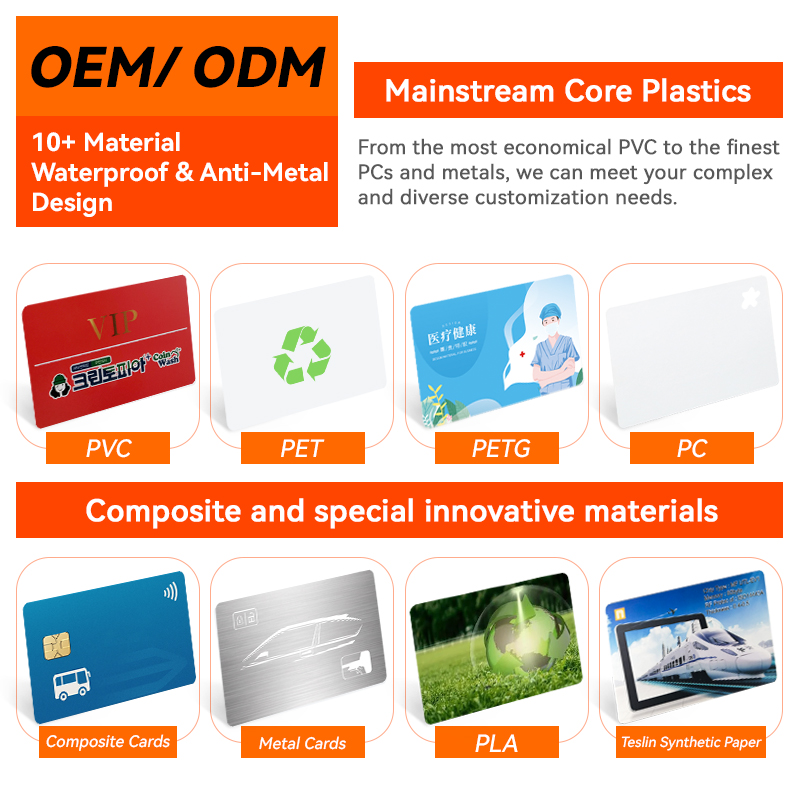
Which material is truly the best fit for your specific use case? Is PVC really obsolete? Which offers better durability — PETG or PC? Can wood cards deliver commercial reliability beyond their luxurious feel? Is metal too expensive or limited in read range? This guide systematically compares the seven most mainstream materials (PVC, PET, PETG, PC, PLA, Wood, Metal) across critical technical dimensions to help you make the most informed decision for access control, payment, asset management, national document, and other key scenarios — avoiding costly mistakes, rework, or end-user dissatisfaction.
PVC, PET, PETG, PC, PLA, wood, metal — each material brings unique strengths and trade-offs in mechanical performance, temperature range, chemical resistance, anti-counterfeiting capability, environmental compliance, processability, weight & tactility, RFID/NFC performance, typical lifespan, and total cost of ownership. Their suitability varies dramatically across applications: hotel key cards prioritize feel and sustainability, national IDs demand forensic-level security and ultra-long life, asset tags require high-temperature and anti-metal performance, and payment cards must balance security with mass-production economics.
Whether you are an issuing authority, system integrator, hotel group, financial card issuer, government document agency, or brand customization provider, this comprehensive material comparison will give you a clear, one-stop view of each material’s real strengths and limitations. Join us as we explore the world of card materials — and help you find the one that perfectly matches your project requirements and long-term vision.