
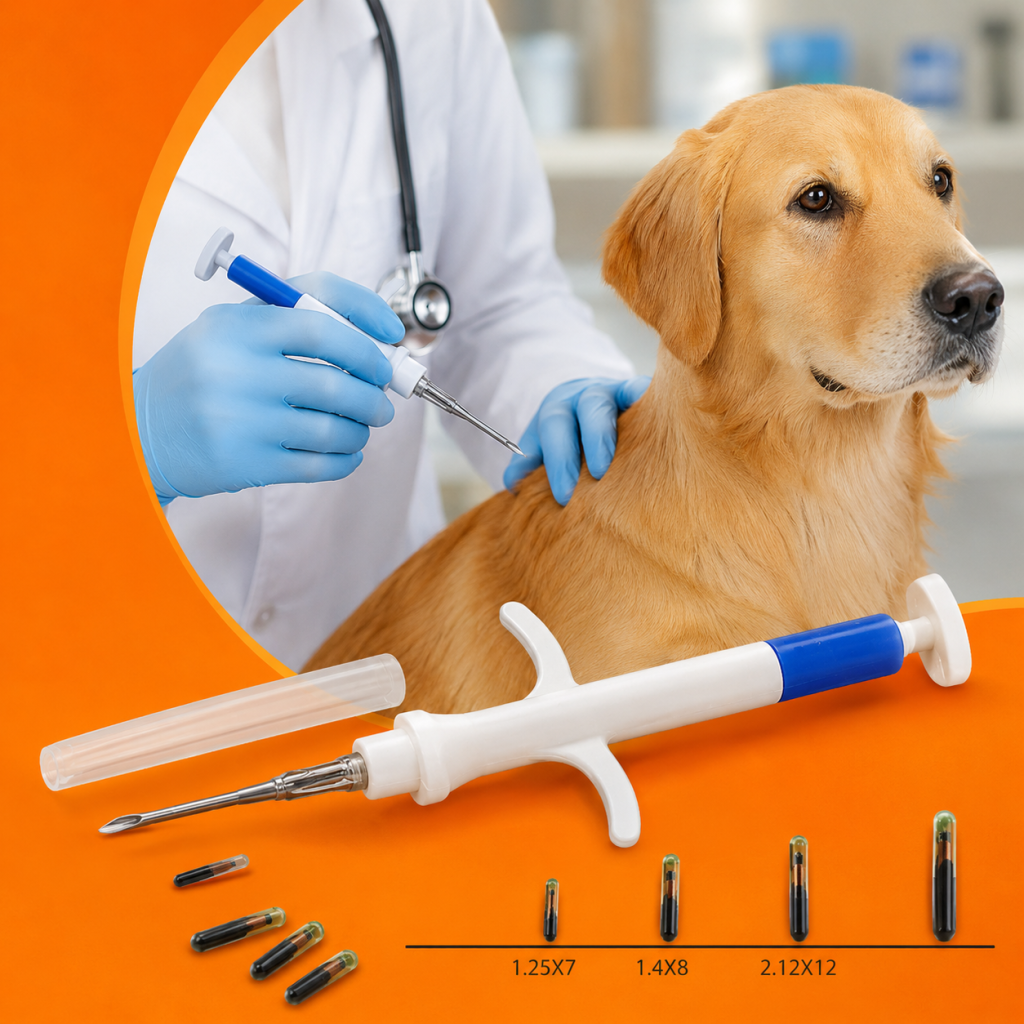
There’s something deeply meaningful about a technology that works without needing to draw attention to itself. There is no collar to slip off, no tag to tear off, and no number to fade. It’s a tiny glass capsule, smaller than a grain of rice, that’s safely placed under a dog’s, a cow’s, a racehorse’s, or even a prized arowana’s skin. For the rest of that animal’s life, it carries a special digital ID that can be read in seconds using a handheld scanner.
This is the RFID animal microchip. It’s a passive, battery-free implant that has quietly become the global standard for permanent animal identification. These chips operate at 134.2 kHz and meet the ISO 11784 and ISO 11785 standards. They have been used far beyond the veterinary clinic. They now deal with pet welfare, managing livestock, registering horses, farming fish, and protecting wildlife.
In companion animals, the impact is deeply personal. Every year, millions of lost pets are reunited with their families because a microchip still carries their registration details. For livestock producers, the same technology supports disease traceability, breeding records, and regulatory compliance without the constant maintenance that ear tags demand. Horse owners rely on it for competition integrity and medical history. In aquaculture and research, the chips allow individual fish to be tracked across years of growth and study. Even conservation teams use them to monitor endangered species without the stress of repeated capture.
Compared with traditional methods — collars, ear tags, tattoos, or brands — the RFID implant offers a rare combination of permanence and minimal invasiveness. It cannot fall off, be deliberately removed, or become unreadable through wear. For animals that live long lives or move across borders, this reliability matters.
Of course, not all microchips are created equal. The quality of the glass encapsulation, the consistency of the anti-migration coating, the precision of the encoding, and the rigor of sterilization all determine how well the implant performs over decades. Choosing a supplier who understands these details — and who can support international standards, custom packaging, and stable production — remains essential for veterinarians, distributors, and livestock projects alike.
As pet ownership rises, livestock systems become more regulated, and digital agriculture expands, the demand for trustworthy permanent identification continues to grow. The RFID animal microchip is unlikely to be replaced anytime soon. It is one of those rare technologies that succeeds by doing its job almost invisibly — quietly carrying identity, history, and ownership beneath the skin for a lifetime.
Guangdong Xinye Intelligent Label Co., Ltd. specializes in high-quality RFID animal identification solutions, including ISO 11784/11785 compliant implantable microchips. With years of manufacturing experience, the company provides reliable bioglass encapsulation, stable encoding, and OEM customization for veterinary distributors, livestock projects, and international animal identification programs.