

What is RFID Ear Tags ?
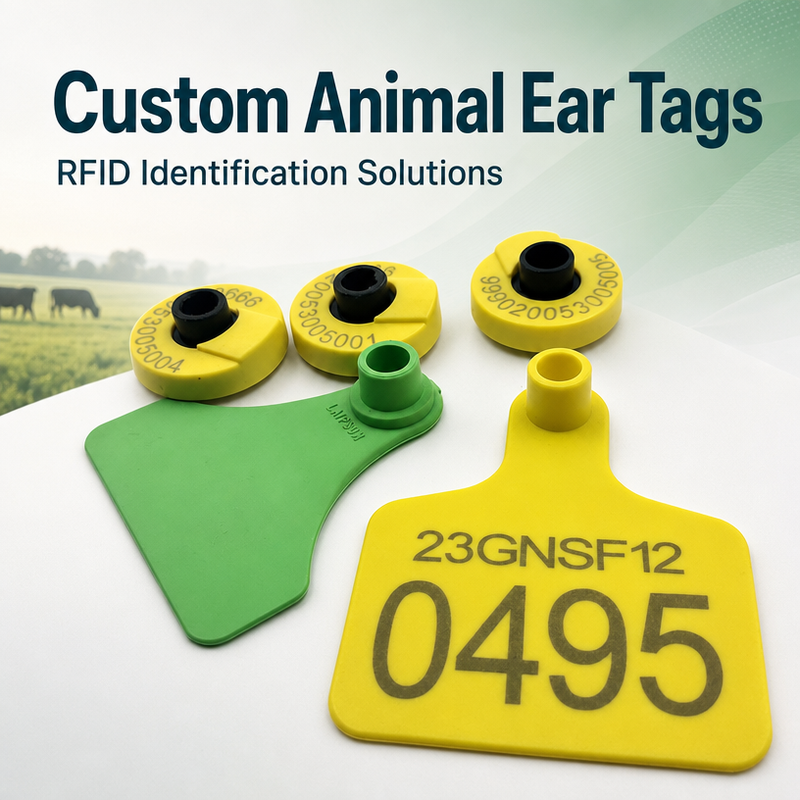
An RFID animal ear tag is a small electronic identification device attached to the ear of livestock, pets, or wildlife. It combines a visual ID number with a radio-frequency identification (RFID) chip, allowing each animal to be identified automatically and uniquely — even at a distance and without line of sight.
Unlike printed or laser-engraved tags that rely on human reading, RFID ear tags store a unique digital ID that can be captured by a handheld or fixed reader in seconds. This makes them the foundation of modern animal identification, traceability, breeding management, and disease-control programs worldwide.
How Do RFID Ear Tags Work?
Each ear tag contains three core components:
An RFID chip — stores a unique identification number and, in some cases, rewritable data.
A copper antenna coil — receives energy from the reader and transmits the ID back.
An encapsulation body — protects the chip and coil from water, dust, UV exposure, and mechanical impact. When a reader emits a radio signal, the tag’s coil captures the energy, powers up the chip, and the chip replies with its stored ID. No battery is required — RFID ear tags are passive devices with a service life of many years.
RFID Protocols: HDX vs. FDX-B Explained
Choosing the right air-interface protocol is one of the most important technical decisions when sourcing ear tags.
FDX-B (Full-Duplex)
- The most widely used global standard, holding roughly 70% of the world market.
- Allows simultaneous two-way communication between reader and tag.
- Lower cost per tag.
- Shorter and slightly less stable read range compared to HDX.
HDX (Half-Duplex)
- Communicates in alternating directions (reader first, then tag).
- Stronger anti-interference capability and a more stable, longer read distance, especially in electrically noisy environments such as metal-rich barns.
- Slightly higher cost per tag.
Practical advice: Most national livestock databases and international trade programs require FDX-B (ISO 11784/11785). If your animals will be exported or recorded in official databases, FDX-B is the safest default. HDX is preferred where maximum read reliability in harsh conditions matters most.
Choose the Manufacture Who Have ICAR Certification
ICAR — the International Committee for Animal Recording — is the global authority for animal identification numbering. Under ICAR rules, every compliant RFID tag carries a unique 15-digit number.
Why ICAR certification matters:
Government tenders and official identification programs typically require ICAR-compliant tags.
It guarantees global uniqueness — no two animals in the world share the same number.
It prevents numbering conflicts when animals are exported or recorded across borders.
TPU RFID Ear Tags Is the Right Choice
The outer body of a high-quality RFID ear tag should be made of TPU (thermoplastic polyurethane), not nylon or PE. TPU material is soft, flexible, and comfortable for the animal; UV-resistant grades withstand years of outdoor exposure.
Encapsulation and Waterproofing: IP67/IP68
Cheap ear tags assemble the housing by pressing upper and lower shells together, which typically achieves only IP65 protection. High-quality tags are produced by two-shot (overmolding) injection molding, bonding the housing seamlessly around the electronics to achieve IP67 or IP68.
A Reliable Partner for Your RFID Animal Tags
Guangdong Xinye Intelligent Label Co., Ltd. has been helping businesses find practical RFID solutions for animal identification. We produce ICAR-certified RFID ear tags to international standards. From original chips and high quality TPU to IP67/IP68 two-shot molding, every detail is made with reliability in mind. We also support custom numbers, logos, colors, and packaging.
Whether you are testing a new idea or building a long-term RFID animal identification program, our engineering team is here to support you from design and sampling to production and delivery. Please free feel to contact our sales team ask for detail information!