
During the widespread adoption of RFID (Radio Frequency Identification) technology, metal environments have always presented a significant technical challenge. Whether it is metal shelving in warehouses, machine tools in factories, servers in data centers, or surgical instruments in hospitals, many of the assets that require identification and management are made of metal.
When conventional RFID tags are attached directly to metal surfaces, their reading distance can drop dramatically or they may even become completely unreadable. RFID anti-metal tags are specifically designed to overcome this challenge. Today, they have become one of the most widely used RFID tag categories in Industrial IoT (IIoT) applications.
Why Do Conventional RFID Tags Have Problems on Metal?
To understand the value of RFID anti-metal tags, it is important to first understand the three main ways metal interferes with conventional RFID tags.
Electromagnetic Wave Reflection
UHF (Ultra-High Frequency) RFID technology relies on electromagnetic waves to transmit energy and information. Metal is a highly conductive material, and when electromagnetic waves hit a metal surface, strong reflections occur.
The incident and reflected waves interfere with each other, disrupting the electromagnetic field distribution around the tag antenna. As a result, the RFID chip may not receive sufficient energy to activate, leading to reading failures.
Antenna Detuning
Conventional RFID dipole antennas are generally designed to operate in air or ordinary dielectric environments. When a standard tag is placed close to a metal surface, electromagnetic coupling between the antenna and the metal changes its equivalent capacitance and inductance, causing the antenna’s resonant frequency to shift.
For example, an antenna originally tuned to the 860–960 MHz frequency range may become detuned when mounted directly on metal. This significantly reduces impedance matching with the RFID reader and decreases energy transfer efficiency.
Eddy Current Losses
An alternating electromagnetic field induces eddy currents inside conductive metal materials. These currents generate an opposing magnetic field that further weakens the original electromagnetic field. They also convert part of the electromagnetic energy into heat, resulting in energy losses.
This effect is particularly problematic for HF (High-Frequency) RFID tags, which rely on magnetic field coupling for communication.
Main Types of RFID Anti-Metal Tags
Based on their physical structure and packaging materials, commercially available RFID anti-metal tags can generally be classified into four categories.
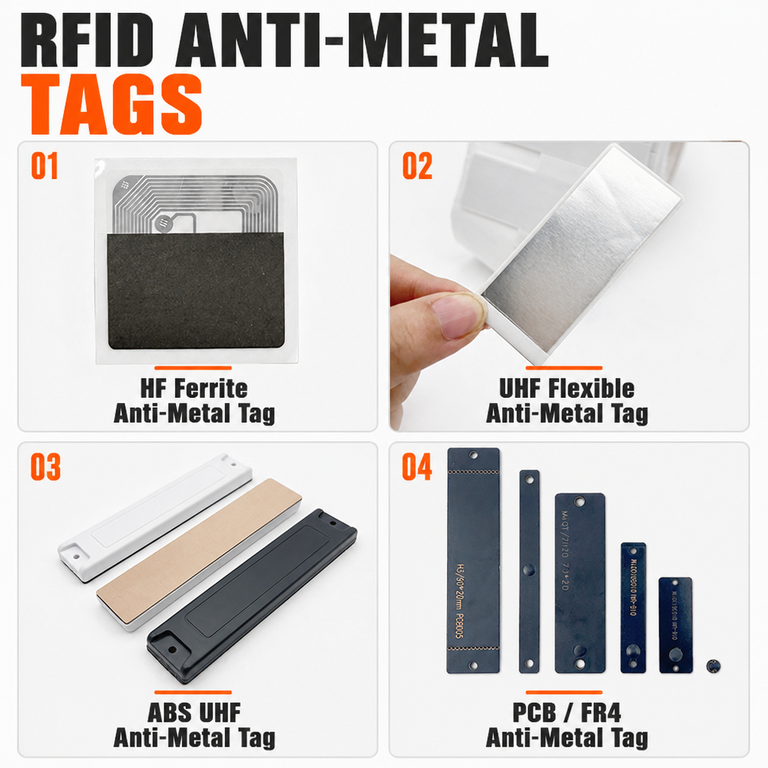
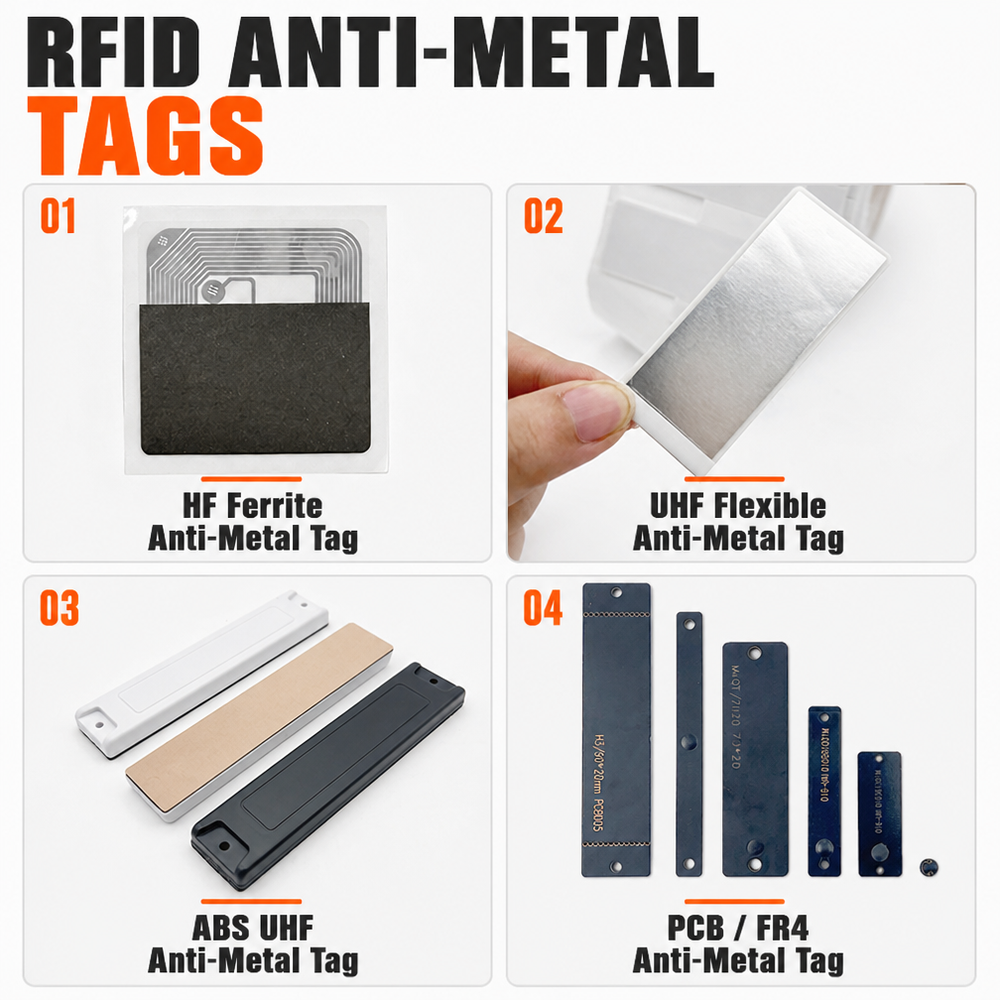
Flexible Printable Anti-Metal RFID Labels:These labels typically combine electromagnetic shielding or absorbing materials with a printable face material. Their thickness is usually around 1 mm, allowing them to remain flexible while supporting batch printing and encoding through RFID printers.
They are particularly suitable for curved assets and large-scale deployments.
Typical applications include:
- IT equipment tracking
- Metal filing cabinet management
- Gas cylinder identification
- Industrial asset tracking
PCB Anti-Metal RFID Tags: PCB anti-metal tags use FR-4 or other circuit board materials as their substrate. They offer stable performance and good manufacturing consistency.
Common configurations include adhesive backing or mounting holes, making them suitable for installation on:
- Industrial pallets
- Returnable transport containers
- Manufacturing molds
- Tools and equipment
ABS / Engineering Plastic Housing RFID Tags: These tags integrate the RFID antenna and chip into a durable ABS or engineering plastic housing.
They provide mechanical protection and can be designed with water and dust resistance, commonly ranging from IP65 to IP68, depending on the product construction.
Some models support screw mounting, riveting, or cable-tie installation, making them suitable for outdoor and demanding industrial environments.
Typical applications include:
- Steel and metal material tracking
- Shipping container management
- Construction machinery identification
- Heavy industrial equipment tracking
Ceramic and Specialized RFID Tags
This category includes high-temperature ceramic RFID tags and miniature tags designed for installation inside metal recesses or specially engineered mounting structures.
They are developed for demanding applications such as:
- Surgical instrument traceability
- Automotive painting and coating production lines
- Die-casting mold management
- High-temperature industrial processes
What Should You Consider When Selecting an RFID Anti-Metal Tag?
There is no universal best RFID anti-metal tag for every application. Product selection involves balancing reading distance, physical dimensions, cost, and environmental resistance.
Balancing Reading Distance and Tag Size
Antenna gain is generally related to physical antenna dimensions. In many designs, smaller tags have shorter reading distances.
For example, a 90 × 25 mm PCB anti-metal tag may achieve a reading distance of over 10 meters under suitable test conditions, while a miniature tag approximately the size of a fingernail may offer a reading distance of around 1 meter.
It is more practical to define the required reading distance first and then determine the maximum acceptable tag size, rather than choosing the smallest possible tag without considering actual performance requirements.
Frequency Bands and Communication Protocols
UHF RFID (860–960 MHz), commonly using EPC Gen2 / ISO 18000-6C protocols, is widely adopted for industrial asset management because of its longer reading distance and ability to identify multiple tags simultaneously.
HF RFID (13.56 MHz) anti-metal solutions are generally used for short-range identification, localized applications, and projects requiring compatibility with NFC-related technologies.
For international projects, buyers should also consider differences in regional frequency regulations.
Real-World Application Testing
The specified reading distance of an RFID tag is usually measured under particular conditions involving a specific metal material and installation method.
Different metals, including aluminum, steel, and stainless steel, can affect RFID performance differently. Other factors, such as the size of the metal surface, tag mounting position, edge proximity, and surrounding metal objects, can also influence actual reading performance.
Therefore, it is essential to conduct on-site testing using real assets and actual RFID readers rather than relying solely on datasheet specifications.
Environmental Conditions and Installation Methods
Different industrial environments have different requirements.
- Outdoor applications: Water resistance, UV resistance, and weather durability.
- Factory environments: Oil resistance, impact resistance, and mechanical durability.
- Painting and sterilization processes: High-temperature resistance and material stability.
Installation methods should also match the application. Adhesive backing is suitable for smooth surfaces, while screws and cable ties are often preferred in high-vibration environments.
When installing flexible tags on curved surfaces, the minimum bending radius should be considered to prevent antenna deformation and frequency detuning.
Typical Industrial Applications of RFID Anti-Metal Tags
RFID anti-metal tags are used across a wide range of industries where metal assets are common.
Manufacturing Industry
Tracking molds, cutting tools, fixtures, and production equipment throughout their entire lifecycle.
Power and Telecommunications
Identifying electrical towers, communication cabinets, and other infrastructure assets for inspection and maintenance management.
Healthcare Industry
Tracking surgical instruments throughout sterilization, storage, and usage processes to improve instrument traceability.
Automotive Industry
Tracking work-in-progress materials and components throughout welding, painting, and other automotive production processes.
Warehousing and Logistics
Managing reusable metal pallets, storage containers, and transport equipment to improve inventory visibility and operational efficiency.